Research & Background

Medical research data rarely speaks one language.

MRI sees anatomy. Laboratory systems record measurements. PET can reveal molecular activity. Genomics, pathology and sensors add still other views. Biomedical synthesis depends on connecting those partial views without losing identity, time, provenance, units or meaning.

The central idea

Discovery can depend on correspondence as much as measurement.

Different instruments are powerful precisely because they see different things. The metadata problem is to make those measurements recognize one another as belonging to the same research context while preserving the differences that make each source scientifically useful.

Instruments create measurements. Metadata creates the connections that let those measurements become a coherent, reviewable research record.
Research problem
Complementary blindness & fragmented data
Architecture
Metadata, crosswalks, provenance & governance
Prototype
A working Biomedical Data Director
Two background papers

The argument and the architecture

1

Diagnostic Synthesis

Biomedical Research Data, Metadata, and Discovery Through Imaging, Genomics, Sensors, and AI

The wider research argument: each biomedical instrument has characteristic strengths and blind spots; synthesis becomes possible when person, time, vocabulary, instrument and provenance can be aligned reliably.

Read on ResearchGate
2

Biomedical Data Director Blueprint

A Persona-Based Agentic AI Architectural Blueprint for Biomedical Research Data, Metadata, Crosswalks, and Governed Publication

The systems response: a domain-specific Data Director architecture for turning the correspondence problem into explicit metadata, crosswalk, provenance, review and publication workflows.

Read on ResearchGate
3

Working Prototype

Medical Research Data Director: Biomedical Metadata & Crosswalk Studio

The implementation layer: synthetic demonstration data, curated example mappings, normalization, quality and provenance checks, reusable exports and an optional AI crosswalk assistant.

Open the prototype
Visual research explainers

See the synthesis problem at a glance

These visual explainers were generated with NotebookLM from the research materials. They are teaching and communication aids rather than authoritative scholarly sources; the linked papers above remain the reference documents.

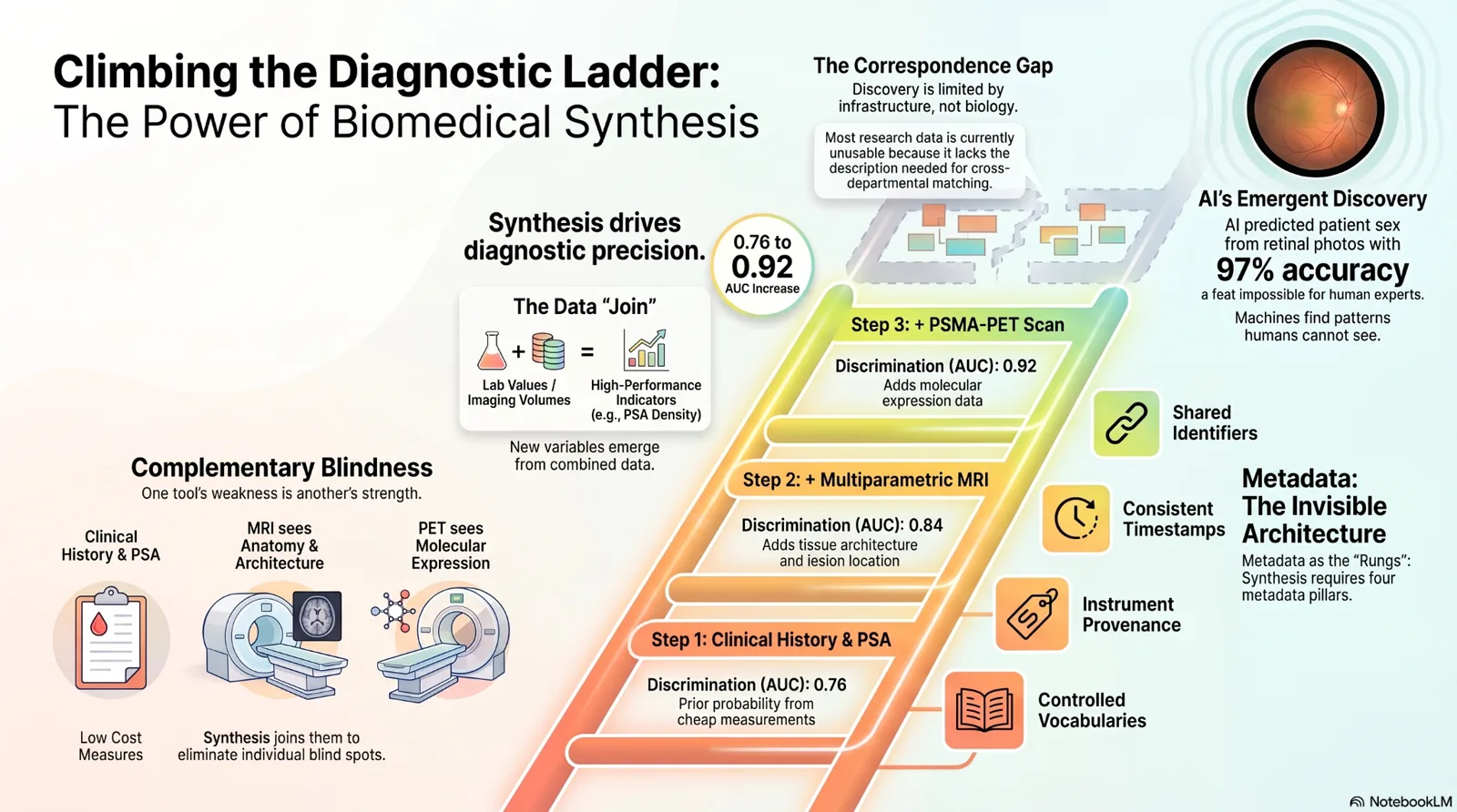
Visual explainer titled Climbing the Diagnostic Ladder: The Power of Biomedical Synthesis
NotebookLM visual explainer
Climbing the Diagnostic Ladder. A public-facing view of complementary blindness, the correspondence gap and the metadata conditions that make multimodal synthesis possible.
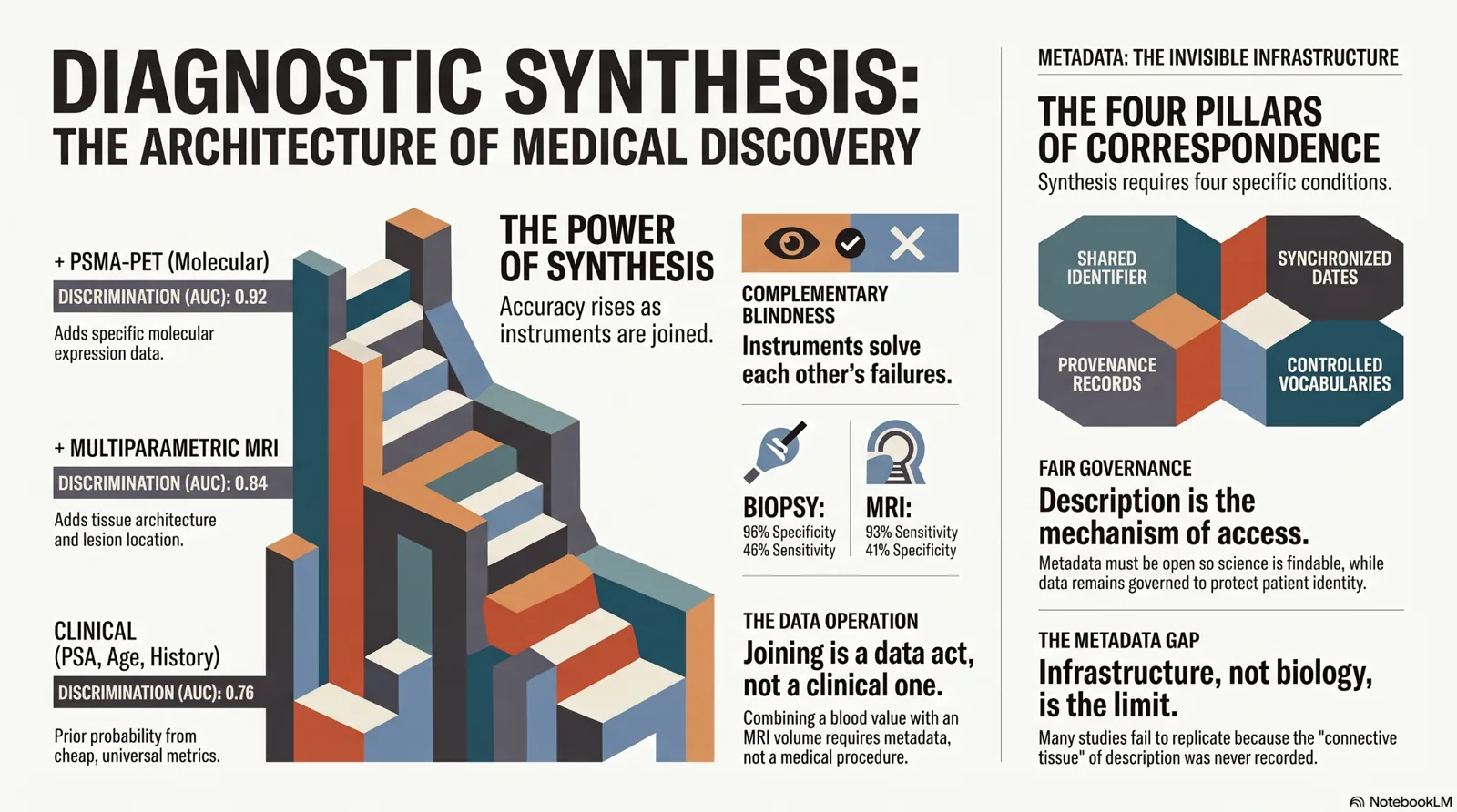
Visual explainer titled Diagnostic Synthesis: The Architecture of Medical Discovery
NotebookLM visual explainer
The Architecture of Medical Discovery. A more structural view of diagnostic synthesis, including complementary blindness, the data operation and metadata pillars of correspondence.
Listen

A longer audio overview

Diagnostic Synthesis — audio discussion

An AI-generated NotebookLM audio discussion based on the research background. Use it as an accessible companion to the papers and visual explainers, not as a substitute for the source documents.

Approx. 24 minutes 36 seconds · web-compressed for streaming

What the prototype adds

From a research claim to an inspectable workflow

Preserve the source

Keep the original variable and value visible instead of replacing local meaning with a standardized label and forgetting where it came from.

Make the bridge explicit

Record the relationship to DICOM, LOINC, SNOMED CT, PI-RADS, UCUM or FHIR together with confidence, status and provenance.

Expose uncertainty

Draft, review and validation states make incomplete or ambiguous mappings visible rather than allowing translation failures to disappear silently.

A clear boundary

Understanding data is not the same as having permission to use it.

The Medical Research Data Director focuses on meaning, interoperability, provenance and review. Decisions about access to sensitive data, secure environments, consent and institutional authorization remain separate privacy and governance responsibilities.

Research-use note. The prototype uses synthetic or properly de-identified metadata only and is not validated for diagnosis, treatment or autonomous terminology assignment. AI-generated visual and audio explainers on this page are communication aids; consult the linked papers and authoritative terminology sources for scholarly or technical reference.